

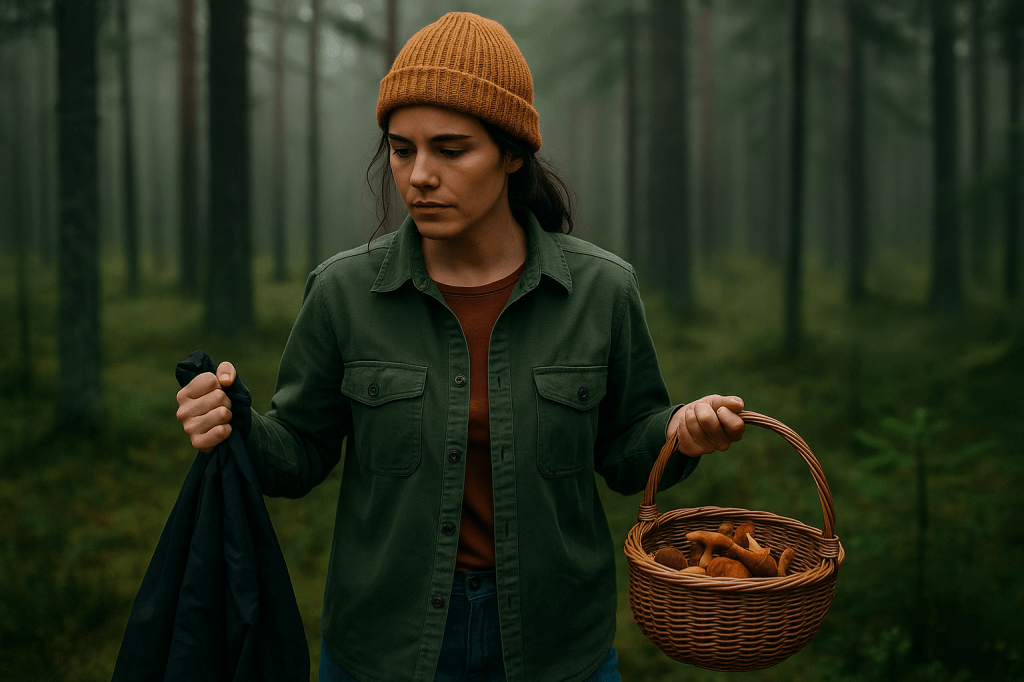
Inspired by the rugged backwoods of the northern wilderness and the quiet legacy of off-grid living, this short story follows a young woman who inherits her estranged father’s remote cabin only to discover a hidden forager’s map sewn into the lining of his old coat. What begins as a search for edible plants and wild mushrooms becomes a deeper journey into survival, memory, and the strange wisdom etched into the forest floor. Scroll to the end to see the original writing prompt that sparked The Map in Her Father’s Coat.
When Mara arrived at the cabin, the silence hit her like a slap.
The structure leaned slightly to one side, as if too tired to stand upright. Shingles had peeled away from the roof. Ivy had crept up from the base and clung to the frame like it belonged there. Her father hadn’t lived in it full-time, not for years, but it still smelled like him: pine tar, pipe tobacco, and old books sealed shut with dust.
She hadn’t seen him in nearly a decade.
The funeral had been brief, unattended but for the lawyer and a pair of curious locals. No eulogy. No stories. Just a pine box, a patch of frozen earth, and one sentence: He left you the cabin. Everything inside is yours.
She found the coat on the first day.
It hung from a nail by the door, stiff with weather and time. Olive canvas, heavy as guilt, with frayed cuffs and something lumpy stitched into the lining. At first she assumed it was padding until she noticed the seam was newer than the rest. She fetched a pair of rusted sewing scissors and slit it open.
Inside was a folded map.
It wasn’t printed. It was drawn by hand in pencil and colored ink, annotated in tiny block letters. Trails wound through the woods beyond the cabin, with markings at intervals: a mushroom icon here, a symbol for berries there. She didn’t recognize half of it, but she understood the intention. This was a forager’s map and it was very detailed. Painfully detailed. Notes like chanterelles late August and blackcaps if frost holds off were squeezed into every margin.
Her father had been many things. But he was, above all else, a man of the woods.
The next morning, Mara zipped the coat up over her hoodie and followed the nearest trail.
The cold nipped at her gloves, but she was moving, and movement meant warmth. The trail was still visible under the mulch and leaf litter just faint enough that it felt like trespassing into another person’s mind. After ten minutes, she found the first mark: a circle drawn around a tree trunk in faded orange paint. Beneath it, moss bloomed thick over a patch of logs. She knelt, brushed the moss back, and found them.
Morels. Dry, golden, perfectly formed. Despite the season, despite logic.
Mara blinked. Impossible.
She gathered three into her pack and stood. The coat crinkled as she moved, no longer just a jacket, but an inheritance. As she wandered deeper, she began to recognize plants from her own childhood: ramps pushing up through dead leaves, wild ginger clinging to the shade. Each one had a place on the map. Each one was marked with his spidery handwriting.
Her father hadn’t just foraged here. He’d studied. He’d lived in rhythm with this place.
By the end of the week, she’d walked every marked trail.
She followed loops through cedar groves, alder thickets, and swampy hollows. One led her to a slope of burdock and fiddleheads. Another to a glade full of wild strawberries, their leaves frost-bitten but alive. She saw patterns in the chaos- species grouped together in ways that didn’t make sense naturally. Someone had once tended this land, though it wasn’t a farm. Not exactly.
And near the edge of the map, hidden behind a stand of spruce, she found the door.
It was nearly buried in soil and pine needles just a dark wood panel sunk into the earth. A steel handle protruded from the top. She cleared it with her boots, heart thudding. The hinges groaned as she pulled.
Below lay a root cellar. Stone walls. A wooden staircase. Cold air breathed up from the dark.
Inside, her flashlight cut a narrow beam through the dust. Crates lined the walls rotting on their edges but still intact. She opened one.
Heirloom seeds. Labeled in pencil: Red Wethersfield, Fish Pepper, Jacob’s Cattle Bean. Others she didn’t recognize at all. There were rows of preserved herbs, jars of dried mushrooms, bundles of dehydrated fruit.
At the far end, an old table held a leather-bound journal. She opened it with trembling fingers.
It wasn’t just a logbook. It was a manual.
Each page was dedicated to a plant or fungus. Drawings. Notes on seasonality, preparation, medicinal uses. Cross-referenced with the map. Some were common: nettle, dandelion, thistle root. Others were obscure. Chaga – double boil, best in snow months. Do not harvest twice from same tree. In the back was a list, titled: Viable Foods, Post-Grid.
She stood there for a long time, reading.
That night, Mara built a fire and sat with the journal in her lap. Her fingers traced his notes, still sharp despite the years.
Her father hadn’t been preparing for retirement. He’d been preparing for collapse.
He hadn’t abandoned the world- he’d predicted its fragility. The woods weren’t a retreat; they were a blueprint. Every plant, every mushroom, every buried seed was part of a map meant to be followed. And now, it was hers.
She slept by the fire and dreamed of cedar smoke and clover tea. In the dream, he stood by the door, coat slung over his shoulder, watching her with quiet approval.
In the weeks that followed, Mara didn’t go back to the city.
Instead, she cleaned the cabin. She preserved herbs. She learned how to dry mushrooms over ash coals and how to identify the faint scent of ripe wild ginger beneath the frost.
Neighbors came by, slowly, carefully. An old woman offered fresh eggs in exchange for a basket of ramps. A teenage boy asked if she knew where to find bee balm for his mother’s cough. They spoke as if her father had never truly died, only changed form.
By the time spring bloomed fully, Mara had added her own notes to the map. New trails. New landmarks. Fresh discoveries among the forest floor.
It wasn’t just foraging anymore.
It was memory work.
And in every stem she harvested, every edible root she uncovered, she felt the map unfolding in her own blood- leading her not just through the woods, but into the heart of a life she didn’t know she was meant to inherit.
Writing Prompt: “After her estranged father dies, a woman inherits his remote forest cabin. Inside, she finds a hand-drawn foraging map hidden in the lining of his old coat, marking trails, edible plants, and strange symbols throughout the woods. As she retraces his steps, she uncovers a hidden root cellar filled with heirloom seeds, preserved herbs, and cryptic notes that suggest he was preparing for something. The deeper she explores, the more she wonders if he was simply surviving off-grid… or safeguarding something far older.“
 Fantasy & Forage
Leave a comment