

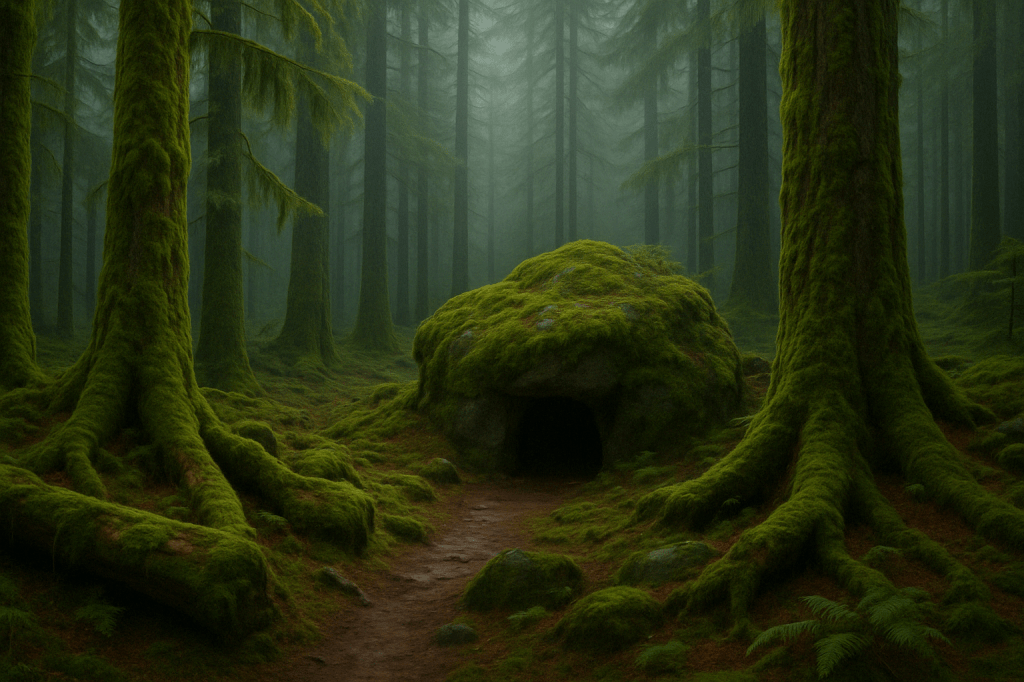
Inspired by the eerie forests of the Pacific Northwest and the thrill of real-life mushroom foraging, this short story follows a seasoned survivalist as he uncovers a cave system where rare edible mushrooms grow in impossible conditions. What begins as a foraging expedition quickly turns into something far stranger. Scroll to the end to see the original writing prompt that sparked Beneath the Moss and Stone.
The moss hung thick on the Douglas firs, draping the forest in green curtains. Rain had just passed, leaving the trail damp and hushed. Most hikers skipped this stretch of the Olympic Peninsula. No trail markers. No cell signal. Just untamed forest.
Jack Mercer wouldn’t have it any other way.
He had spent over twenty years mastering wilderness survival. Tracking animals, reading soil, building fire in sideways rain. Foraging came naturally to him, especially when it came to edible mushrooms in the Pacific Northwest.
The morning had already been fruitful. He found a flush of golden chanterelles near the base of a dying cedar. Nearby, a shaggy cluster of lion’s mane mushrooms clung to a birch stump. Either find would have made the trip worthwhile.
Then he noticed something unusual.
A narrow trail broke away from the slope, almost hidden beneath pine needles and ferns. He crouched, brushing the surface with a gloved hand. Human footprints. Old, but deliberate. They led down into a ravine.
Jack followed.
The forest thickened. Fog moved like breath through the trees, curling around trunks and catching in the branches. Jack moved carefully, using a walking stick to test the slope. The trail dropped into a hollow where a wide rock formation stood, split through the middle like a cracked tooth.
A dark opening yawned at its base.
A cave.
Jack knelt beside the entrance and sniffed. The air was warmer than the forest above, damp with the scent of minerals and earth. He turned on his flashlight and stepped inside.
The interior pulsed with moisture. Condensation ran in rivulets down the walls. Glowing fungi clung to the stone. Green, orange, and blue clusters that twitched ever so slightly under the beam of light. It was like stepping into a world untouched by time.
Then he saw them.
Mushrooms unlike anything in his books. Tall caps, pale beige, with blood-red gills and wide stalks that twisted like bone. They grew in tight circles, rings within rings, and seemed to emit a faint shimmer.
Jack crouched and pulled out his field notebook. He scribbled notes: limestone substrate, high humidity, no visible light source, steady temperature. Conditions like these were rare for fruiting bodies, especially mushrooms that looked mature and healthy.
He raised his camera to take a photo.
The battery died.
He frowned and pulled out a sample vial. But before he could snip a piece of the cap, something caught his eye beneath a nearby rock shelf. Fabric. Moldy. A backpack. Torn at the straps.
Beside it, a notebook. The cover had warped with moisture, but the pages were mostly intact.
He flipped through it.
The early notes looked familiar. Foraging tips, tree indicators, soil temperature readings, sketches of common wild mushrooms. But the entries grew scattered. Chaotic. The handwriting became uneven, slanted, scratched like the writer had been in a hurry.
They mentioned the mushrooms.
“I found them. They were breathing. I think they’re alive in a way we don’t understand.”
“They don’t want me to leave.”
“They change places when I’m not looking.”
The final page simply said:
“Do not eat the red ones.”
Jack closed the notebook and slipped it into his jacket.
The air had changed.
He turned back toward the entrance. His flashlight flickered. The once-short path to the cave mouth now stretched longer. Or maybe he was imagining it. The stone walls pulsed with light from the bioluminescent fungi. It was easy to lose direction here.
He moved faster.
But the cave twisted. His charcoal marks were gone. Each passage looked identical. His compass spun without settling.
He stopped to calm his breath.
A soft hum reached his ears. Not mechanical. Not human. It was low, like the vibration of distant thunder muffled through stone.
He turned and caught movement out of the corner of his eye.
A mushroom tilted slightly, as if watching.
He walked. Then jogged. Then ran.
His steps echoed unnaturally. The passage narrowed and widened, never in the same places. He began marking the walls again, this time with cuts from his knife. But when he circled back, they had vanished.
Finally, he saw a sliver of light ahead.
Jack sprinted, burst through the cave mouth, and collapsed on wet leaves outside. His hands scraped against bark and root. He looked around.
This wasn’t where he had entered.
The terrain had changed. The moss felt wrong under his palms. The light filtering through the canopy had a silvery hue. No familiar landmarks. No trail behind him. Only forest.
He pulled out the journal.
A crude hand-drawn map spanned one page. It showed the location of the cave and marked several other spots with red Xs. In the margin, a message was scrawled:
“If you make it out, tell someone. This place should stay lost.”
Jack stuffed it away.
He checked his gear. His food was untouched, but the sample was gone. His GPS refused to turn on. The compass needle trembled as if unsure which way to point.
Still, he was a survivalist.
He scanned the tree line. Spotted birch, alder, and a patch of young maple. These species often bordered mushroom-rich zones. Nearby, fiddlehead ferns curled beside a fallen log. Good indicators.
He picked a direction.
He would follow the forest signs. Track the slope. Use sun breaks to gauge time and location. Somewhere, there had to be a ridge or a clearing that would lead him out.
As he walked, the air grew colder.
Behind him, the forest remained still.
But deep beneath moss and stone, the cave waited. The mushrooms, whatever they were, continued to grow.
And Jack knew he hadn’t been the first to find them.
Writing Prompt: “A seasoned survivalist stumbles upon a hidden cave system in the Pacific Northwest where rare edible mushrooms grow in defiance of all known ecological rules. As he explores deeper, he finds signs that he’s not the first to discover this place and the last person never came back.”
 Fantasy & Forage
Leave a comment