

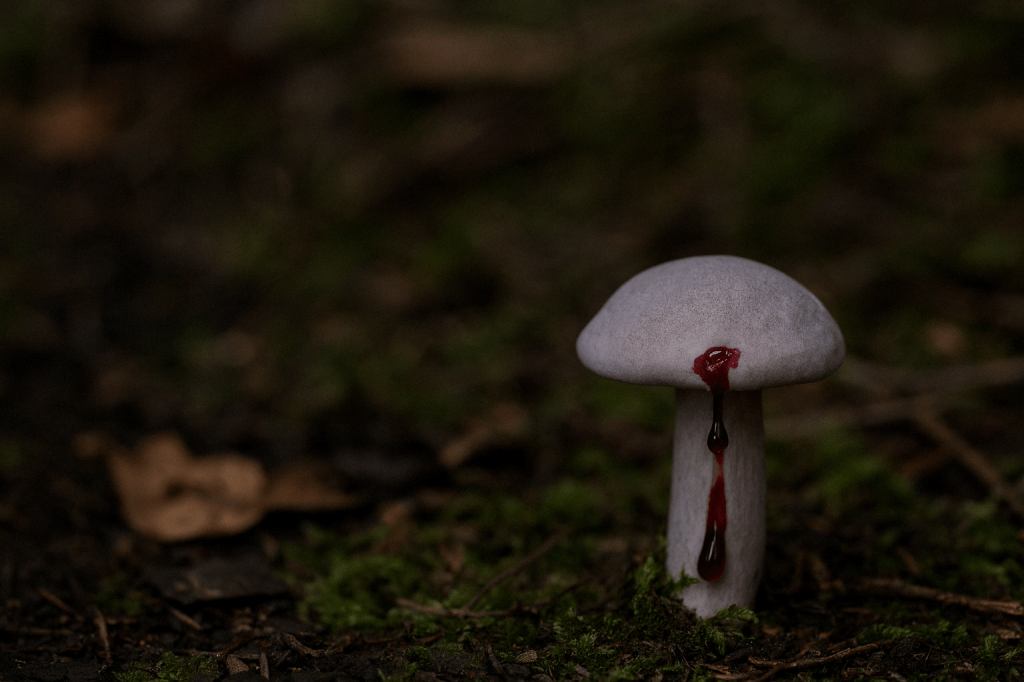
Inspired by the haunting intersection of mycology and forgotten history, this short story digs into the soil of grief, memory, and strange fungal life. Where wild mushrooms bloom near old trauma sites, what secrets do they remember? Scroll to the end for the original writing prompt that unearthed The Bleeding Cap.
The forest near Stillwater had no marked trails, no campgrounds, and no cell reception. Which was exactly why Dr. Ezra Mollen chose it. He wasn’t hiding from anyone, at least not in the way people assumed. Ezra had just seen too much of the world. War zones. Disease outbreaks. Forests clear-cut in weeks. He once ran a university lab, taught eager students how to culture spores and classify gills. But all that had burned out of him like the last glow in a dying agar dish.
Now, he lived alone in a cabin stitched into the base of the ridgeline. Most days were quiet, broken only by wind, birdsong, and the occasional creak of timber from his roof. He kept a field journal, collected samples, photographed wild edible mushrooms for academic journals he no longer submitted to. It was enough.
Until the cap started bleeding.
He’d found it deep in a gully, two miles from his cabin, at the foot of an old stone foundation. The forest around it felt colder than it should have. Even the air hummed with stillness. Ezra crouched beside the fungus, brushing leaves away with care.
It was shaped like a bell, somewhere between a morel and a waxcap, with a smooth, grey-violet skin. But the strangest thing was the fluid. When he nicked the edge with his scalpel, red droplets welled at the cut, thick as blood and smelling faintly metallic. No other species in his catalog matched it.
He labeled it Mycena lacrimosis in his notes and took samples back to the cabin.
The next few days passed in a flurry of tests. He cultured the spores on agar. They grew fast, too fast, and under the microscope they showed branching mycelium that shimmered slightly at the edges. When he tested the red exudate for chemical composition, the results didn’t make sense. The fluid was hemoglobin-like. Close enough to mimic blood, but structurally wrong. It wasn’t from any mammal.
Ezra wrote down everything. He wanted to believe it was just an unknown species, perhaps a rare mutation. But the more he studied, the more the strangeness took hold.
Each new specimen appeared only near ruins or old burial sites. Stone foundations, collapsed cabins, even a forgotten logging camp with rusted axes still lying in the underbrush. The mushrooms didn’t just grow they clustered. Like they were feeding on something beneath the soil.
One night, while flipping through his notebook by lantern light, Ezra paused on a detail he hadn’t thought much about. Every location had a known history of death. Violent death.
The cabin site had been a quarantined camp during the 1918 flu. The logging site, home to a strike turned massacre. The stone ruins, once a mission burned down in a settler raid. None of that was secret, just buried in obscure state records.
But the mushrooms knew.
Ezra stopped collecting. He just walked, sometimes for hours, hiking farther into the backwoods with a strange mix of dread and curiosity. He began calling the species “the bleeding cap.” Local enough, dramatic enough, and easier than explaining what he suspected.
In early October, he visited the ravine where he’d first found it. More had sprouted now, ringed in a rough spiral, following the slope of the gully like a slow exhalation. He knelt down, not to collect but to listen. He didn’t know why. He just knew the woods had changed.
The cold arrived early that year. Frost dusted the leaves by mid-month. Ezra kept the fireplace lit and refused to open the specimen drawer. The cultures were still growing. Some had reached the edges of their petri dishes and started pushing up tiny caps caps that wept even under glass.
Then, the dream started.
It came three nights in a row. Ezra walking through fog, past trees blackened by fire. Ash covering the ground like snow. And there in the center of the clearing, a ring of bleeding caps. Inside it, something buried. Something human.
He woke up each time with his heart pounding, palms slick with sweat. The dreams weren’t just dreams. He could feel the forest inside them. Smell the pine needles and scorched bark. Hear the wind over ruined beams.
By the fourth night, he gave in.
Ezra packed a bag before dawn, laced his boots tight, and hiked north. No map. No trail. Just a direction etched in his mind like a scar. He walked for hours, deeper than he’d ever gone before. The woods here were older. Denser. The light barely filtered through the canopy.
By midafternoon, he found the place.
The trees opened into a shallow basin, rimmed by hemlocks. In the center stood the frame of a longhouse, nearly collapsed. Stone hearth, rotting beams, scorched earth. And everywhere around it, clusters of the bleeding cap. Hundreds of them.
Ezra stood still, cold rising through his boots.
The caps weren’t just growing they were blooming in a pattern. A ring, again. He stepped forward, careful not to crush any. In the center of the circle, the soil was soft. Fresher. As if something had been recently unearthed or buried.
He dropped to his knees and began to dig.
Not with tools. Just hands. Earth under his nails. Damp moss flung aside. Five inches down, his fingers scraped wood. Then cloth. Then something that wasn’t quite bone, but wasn’t anything else he could name either.
He sat back, breathing hard. In his mind, the fog from the dream returned, curling around the trees. And beneath it all, a whisper. Not words. Not voices. Just memory, pressed into soil.
The bleeding cap didn’t feed on rot. It fed on grief.
Ezra left the pit untouched and hiked back in silence. He said nothing. Wrote nothing. Weeks passed. Snow came early. The forest went still again.
In December, a letter arrived. No return address. Just a wax seal and yellowed paper.
Dr. Mollen,
We are aware of your findings. You are not the first to discover them, but you may be the last to truly see.
Do not attempt to publish. Do not disturb the growth sites further. These species are not just biological they are memorial.
Some memories are meant to remain underground.
Ezra burned the letter in the fireplace.
But he didn’t stop walking. Every week, no matter the snow, he strapped on his boots and headed into the forest. Not to collect. Not to study. Just to witness.
To visit the places where the bleeding cap still grew.
He never brought a camera again.
And he never once stepped into the center of the ring.
Writing Prompt: A reclusive mycologist discovers a species of mushroom that only grows near sites of ancient trauma.
 Fantasy & Forage
Leave a comment